Because, short term, we need to win in November or descend into fascism. But this is not a political blog so I will leave it at that.
Instead, I’ll recommend some othe reading: Andrew Spring writes:
From the very first words to the very last verse, the writings of the Bible document the best and worst of human action and belief. It is a work of literature that can do tremendous harm—but also tremendous good.
This uncomfortable fact is usually lost on those of us who left the religion about Jesus—Christianity—in search of the religion of Jesus. (The former is the invention of rich men trying to control humanity, the latter is the radical and world-changing spirituality and ethical living preached by an ancient prophet.)
The bible is not one book – it’s a library. The Bible is a collection of writings, and the word comes from the Greek biblia, which means “the books,” plural. It’s sort of like saying The Library.
It would be like asking what your favorite Beatles song is and saying Abbey Road. Clearly you don’t know what you’re talking about, because Abbey Road is not one song, but a collection of songs—just as the Bible is not one writing but a collection of writings.
But unlike Abbey Road, each of the writings of the Bible have different authors. (I double checked: almost all the songs on Abbey Road were written by both Lennon and McCartney, except three that were written by George or Ringo.²) And each writing was done in a different location, with different audiences and—wait for it—different purposes.
Perhaps some Christians refuse to acknowledge this, because if the Bible is a collection of writings, that means somebody had to put them together.Looked at through this lens, the Bible becomes much more human—and much more prone to error.
Google Andrew Spring to read more. He can be controversial but that’s good, it makes you think.
There is also a substack post called “She’s So Scripture”
Luke 19:2 says “Here was a man by the name of Zacchaeus; he was a chief tax collector, and he was rich.”
In those days, being a tax collector was sort of a franchise. You paid the Romans an up-front fee and then a percentage of your take. But you kept the balance. This was a path to riches, and to becoming the most hated man in your neck of the woods.
The Jewish community considered tax collectors so compromised, so ceremonially and morally unclean, that they were grouped in religious literature alongside prostitutes. They were barred from giving testimony in court. They could not hold religious office.
In the eyes of their own community, they had forfeited their place among the people of God. They were traitors, collaborators, and thieves, all three at once, and Zacchaeus was the most successful one in town.
His name, incidentally, means pure or innocent. The irony was not lost on any one hearing this from an Apostle.
It seems he was a short little man, with all the insecurities one often finds in shorter people.
Luke continues: Zaccheus was trying to see who Jesus was, and was unable because of the crowd, for he was small in stature. So he ran on ahead and climbed up into a sycamore tree in order to see him, for Jesus was about to pass through that way. When Jesus came to the place, he looked up and said to him, “Zaccheus, hurry and come down, for today I must stay at your house.”
Now in those days (and now), to have someone over for dinner suggests at least a certain level of honor. We rarely invite people we consider pond scum into our homes. Nor do we choose to dine with those we consider pond scum.
Jesus looked at the most hated man in Jericho and said publicly, in front of a crowd of people who had been waiting to see a miracle: I’m going to his house. Today.
The crowd’s reaction tells you everything. When they saw it, they all began to grumble, saying, “He has gone to be the guest of a man who is a sinner.”
Now, the word grumble in the Greek, διεγόγγυζον(diegongyzon), is the same word used in the Septuagint for Israel’s complaints in the wilderness. Luke’s audience, steeped in the old testament, would have caught the comparison immediately. They were as unhappy at Jesus’s behavior as the Israelis had been when lost in the desert. This is not a mild grumble – it’s a shock.
What happens next is even more of a shock. Zaccheus immediately says to Jesus that he will give half of my possessions to the poor. And if I’ve defrauded anyone I will pay back four times over.
Jesus said to him, “Today salvation has come to this house, because he, too, is a son of Abraham. For the Son of Man has come to seek and to save that which was lost.”
Jesus had not asked Zacchaeus to clean up his act first. He had not required a confession before extending the invitation. He walked up to the man and offered him relationship before Zacchaeus had done a single thing to earn it.
Half his possessions to the poor. Torah did not require this. There is no commandment that says give away fifty percent of everything you own. This was radical, voluntary, economy-altering generosity that would have fundamentally changed Zacchaeus’s financial position.
Four times as much for anyone he had cheated. This is where it gets really precise. Exodus 22:1 required fourfold restitution for the theft of livestock, animals that could reproduce and whose loss compounded over time.
It was the Torah’s highest restitution requirement, reserved for the most serious categories of theft. Zacchaeus was not meeting the legal minimum. He was voluntarily applying the maximum standard to his own case, treating every act of extortion as worthy of the most serious Torah consequence.
This is not a man making a general promise to do better. This is a man who knew the law, named the specific legal remedy, and applied it to himself without being asked. He was stating his own guilt and his own sentence in the same breath and doing it in front of a crowd that despised him.
The key point is that Jesus extended grace before repentance came. He offered relationship before Zacchaeus had done anything to deserve it. And that grace, that completely unearned, publicly scandalous, crowd-offending grace, is exactly what produced the repentance. Zacchaeus did not clean himself up and then get invited to dinner. He got invited to dinner and the invitation changed EVERYTHING.
The crowd thought the question was whether Zacchaeus was worthy of Jesus’s company. Jesus was not interested in that question. His question was whether Jesus was lost and whether he could find him. And the answer was yes and yes. He was the one amongst the ninety-nine.
The Son of Man came to seek and save the lost. Not the almost-lost. Not the lost who had already started making their way back. The ones still up in trees, watching from a distance, fairly certain they were too far gone to be the ones He was actually looking for. This is a pretty high bar for the rest of us.
I’m not sure I could extend grace, friendship, or much of anything else to Stephen Miller. He’s the one really pulling the strings at the White House, then man who wrote much of Project 2025, the man who is ripping babies from their families, the man who is terrified there might be more Americans with brown skin. Perhaps Jesus will use his grace for Stephen, and the cabal of others in the White House who are treating Americans far worse than Zacchaeus treated his neighbors. ‘Tis a thing devoutly to be wished for, but I am not my breath holding.
Around April, we all tend to think about money, and taxes, and rendering unto Ceasar. I’ve been working with my investment advisor to decide which stocks and bonds to invest it. Some investments can be very risky – a huge reward is possible, but so is gong broke.Jesus tells of a master who is going on a journey. Before he leaves, he entrusts his servants with his wealth:
• To one, he gives five talents
• To another, two
• To another, one
Each servant according to their ability.
The first servant looks around for an investment with a high return, and he’s lucky – he doubles the money.
The second servant is more risk adverse, so he loans some money to trusted friends, and makes a modest return
The third servant knows that his master is old, and this money is to keep him alive when he is too old to work. So he buries the money, secretly, for safekeeping.
The master praises the first two servants, equally, but is rather harsh with the third. Personally, I think he was a bit too harsh – the third servant wasn’t lazy or careless; he just didn’t understand the assignment.
Now when I first read this, I saw the first two servants as riverboat gamblers who got lucky. I figured I’d hire the third one, because he kept the money safe. Wouldn’t you do something similar?
The word ’talent’ here is used to mean a sum of money, in particular gold. Google says one talent is about 75 pounds, worth roughly $5 million.
But nowadays the word talent means something closer to skill, or artistic mastery. I find this ironic, in light of what Jesus evidently meant by this parable. The servants who use their talents to spread the Word of God and the teaching of Jesus are doing the right thing. The third servant is wasting what we can take to represent his God-given talent, not merely money.
OK, I mis-understood this parable. But there is a connection: the use of the word “talent” to mean “gift or skill” in English and other languages originated from an interpretation of this parable, sometime in the 1200s AD, or thereabouts,
Besides the etymology of the word Talent, what can we learn fro this parable?
The question is not, “What do I have?” The question is, “What am I doing with what I have?”
Notice something important: the servant with two talents received the same praise as the one with five. Jesus is telling us to use the talents we have to create goodness in the world. Maybe you don’t create as much as some other person, but Jesus is telling us that it doesn’t matter.
Teddy Roosevelt understood this. He said “The credit belongs to the man who is actually in the arena, whose face is marred by dust and sweat and blood; who strives valiantly; who errs, who comes short again and again, because there is no effort without error and shortcoming; but who does actually strive to do the deeds; who knows great enthusiasms, the great devotions; who spends himself in a worthy cause; who at the best knows in the end the triumph of high achievement, and who at the worst, if he fails, at least fails while daring greatly, so that his place shall never be with those cold and timid souls who neither know victory nor defeat.” Personally, I think Teddy’s version avoids the confusion over mere money, but that’s just me.
The Christian life is not about preservation—it is about multiplication. About increasing the amount of love and kindness in the world.
This is the fiftieth anniversary of the movie about Watergate, “All the President’s Men”. You remember, the one where a source on background kept meeting one of the reporters in a parking garage. He was nick-named “Deep Throat”, and his most useful tip was “Follow the Money.”
Apparently Jesus saw the previews, because he says: “For where your treasure is, there your heart will be also.”
This simple sentence cuts straight to the center of our lives.
We spend so much time chasing things—money, success, recognition, comfort. None of these are evil in themselves. But Jesus is warning us: whatever you value most will shape your heart.
In this author’s experience, it is excellent advice in general Want to know why some corporation has what appears to be a silly rule? Follow the money. It’s not always bad to follow the money, at least in business. It explains a lot about business behavior.
But if your treasure is wealth, your heart will live in fear of losing it. Or if your treasure is status, your heart will constantly compare yourself to others, and like as not come up short. If your treasure is comfort, your heart will avoid sacrifice.
On the other hand,if your treasure is God—if your treasure is love and truth, then your heart becomes steady, generous, and full of peace.
Jesus isn’t just telling us to feel differently. He’s telling us to invest differently.
Think about it this way:
• What do you think about the most?
• What do you protect the most?
• What do you pursue when no one is watching?
That is your treasure.
And here’s the hope in Jesus’ teaching: You can move your treasure, and when you do, your heart will follow. When you give instead of hoard, your heart grows generous. When you serve instead of seek attention, your heart grows humble. When you trust God instead of clinging to control, your heart grows peaceful.
Jesus is inviting us to a better kind of wealth—one that cannot rust, fade, or be taken away.
So today, take a moment and ask yourself, Where is my treasure?
Because wherever it is… that’s where your heart is living.
A man once asked Jesus, “Who is my neighbor?” It’s a question we still ask today—sometimes out loud, sometimes in how we live.
Jesus answered not with a definition, but with a story.
A man from Galilee’s was beaten, robbed, and left for dead on a road. He cried out for help, but two respected, religious men saw him and passed by. A squad of soldiers came by, and vowed to hunt down the robbers and smite them with the Lord’d Vengeance.
Then a man from Samaria came by. The victim was saddened, because Samaritans and Galileans don’t always get along. But the Samaritan stopped and bandaged the man’s wounds, then helped him to his feet. Together they managed to limp into the nearest village.
Jesus asked his questioner, Which one was the neighbor?
The answer is clear: the one who showed mercy.
The lesson is just as clear—and just as challenging.
Being a neighbor isn’t about proximity. It’s not about who is like us, agrees with us, or belongs to our group. It’s about how we respond when we see someone in need.
We live in a world full of reasons to pass by:
“I’m too busy.”
“Someone else will help.”
“They don’t deserve it.”
But Jesus calls us to something higher.
He calls us to see people.
To stop even when it’s inconvenient. Maybe even especially then.
To help even when there might be some risk or danger.
To love without conditions.
Because real love isn’t theoretical—it’s practical. It shows up. It gets its hands dirty. It crosses boundaries.
So today, ask yourself:
Who is lying on the road in your life? Who have you been walking past?
They may not be near by. They may be in Ukraine, or Sudan. Or they may be sleeping under a bridge just down the street from you.
And then hear Jesus’ final words in that story: “Go and do likewise.” So, like, do it already!
This book was first published in 1973. It’s not long, and quite readable, so I encourage you to read it.
Jesus said he had not come to change the law, but to uphold it. On the other hand, he and his disciples did things on the Sabbath that were fobidden – healing the sick, eating in un-approved ways. So which laws was Jesus upholding?
One suspects he means common-sense laws. He points out that nothing that goes into a man can defile him, but things that come out can (and often do).
He overturned the tables of the money-changers and cal them a pack of thieves. He was correct to do so – the temple authorities had rigged the system by requiring you to change your money at usurious rates.
Can you suggest other examples of him applying a common-sense take on Mosaic law? I’d lov to hear from you!
The Gospels are not as clear on this pint as one might wish. In Matthew 20:28, he says he is giving his life as ransom for many. Well, that sort of means that….. sort if. But it culd also me he is leading an uprising, and does not expect to survive the battle.
During the last supper, he reminds us to think of him when we eat or drink, and that the wine/blood is poured out for many for the forgiveness of sins.
Certain of the letters are more explicit on this point. First Corinthians 15:3 and Romans 5:8 both address the point. But these are the words of others, not Jesus.
I’ve always had a bit of trouble wth this concept. Which of my sins did he die for? If it’s all of them, that sounds like a free pass. I’m sure that is not what is meant. Centuries later, the church decided that we are all guilty of the original sin, of Eve eating the fruit in the Garden of Eden. This feels like something made up after that fact, to paper over a hole. If we are all guilty of at least this sin, then we all have to go to church, put money in the collection plate, and be forgiven. Bit of a racket, that.
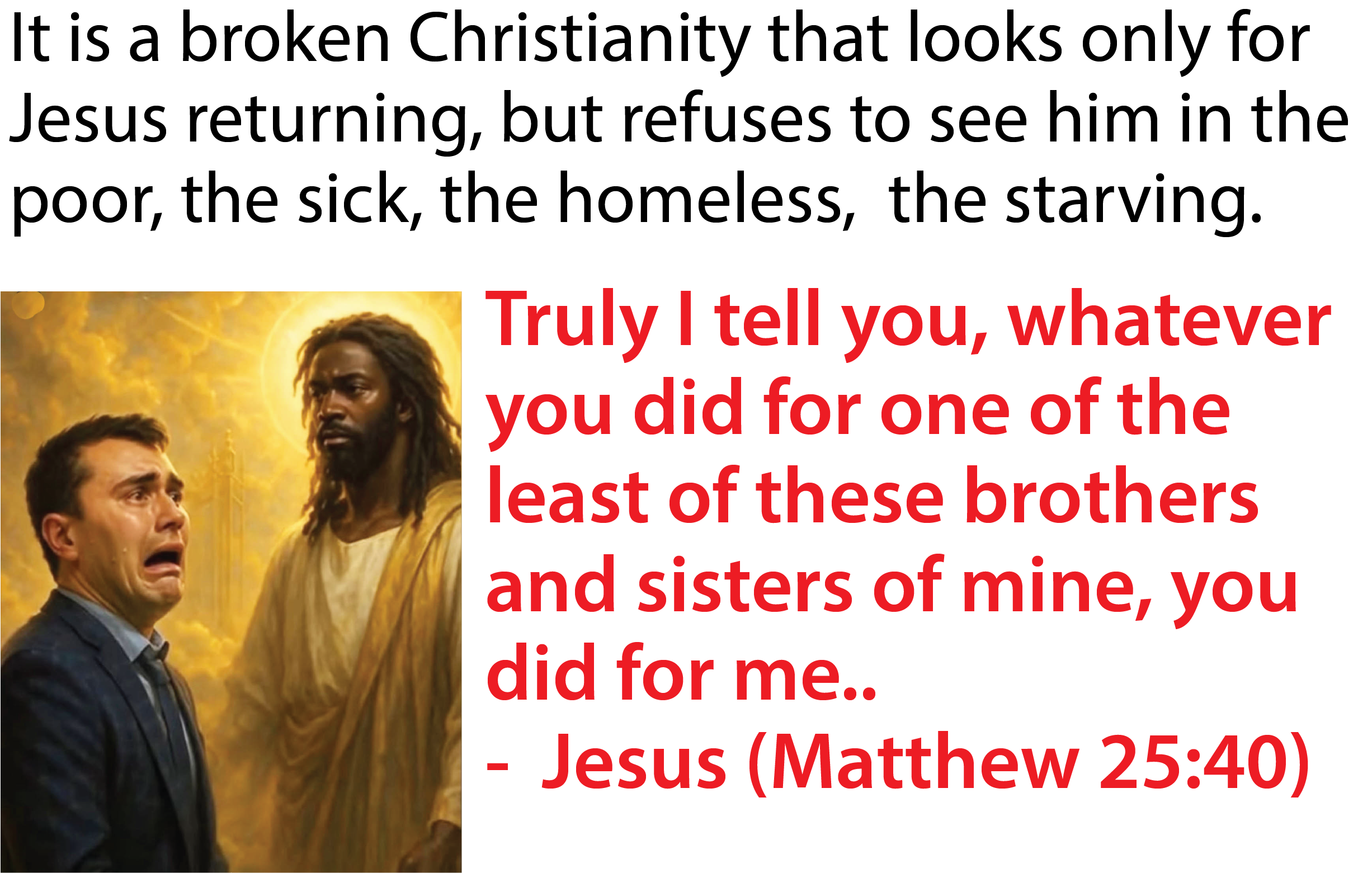
In Matthew 40 there is the story of the sheep and the goats. It goes something like this:
Jesus separated the people one from another as a shepherd separates the sheep from the goats. He put the sheep on his right and the goats on his left. He said to those on his right, “Come; take your inheritance, the kingdom prepared for you since the creation of the world!
For I was hungry and you gave me something to eat, I was thirsty and you gave me something to drink. I was a stranger and you invited me in. I needed clothes and you clothed me, I was sick and you looked after me. I was in prison and you came to visit me.” Those on his right asked, “Jesus, when did we see you hungry and feed you, or thirsty and give you something to drink? When did we see you a stranger and invite you in, or needing clothes and clothe you? When did we see you sick or in prison and go to visit you?” Jesus replied, “Whatever you have done for one of the least of these brothers and sisters of mine, you did for me.”
Then he will say to those on his left, “Depart from me to the eternal fire prepared for you. When I was hungry you gave me nothing to eat. I was thirsty but you gave me nothing to drink. I was a stranger and you did not invite me in. I needed clothes but you did not clothe me. I was sick and in prison and you did not look after me.” This on his left asked, “Jesus, when did we see you hungry or thirsty or a stranger or needing clothes or sick or in prison, and did not help you?” Jesus replied, “Whatever you have not do for one of the least of these, you did not do for me.”
So what can we learn from this?
Well, it is pretty obvious that Jesus wants us to help the less fortunate, the “sad accidents of Fortune’s careless aim.” (I’ve always liked that phrase…. such folks are out there, usually through no fault of their own.)
Christmas can be a high-stress time for people – it can get expensive; there are many – perhaps too many – social obligations. The days are short; the nights longs and dark. It’s a good time to give money to a local charity – and maybe even directly to someone who needs it. They will feel better. I’d guess you will too.
“Truly I tell you, whatever you did for the least of these brothers and sisters of mine, you did for me.”
It’s pretty clear that Jesus wants us to help the less fortunate among us, and not just of our own tribe. He helped the Samaritan woman at the well, and the Syrophoenician woman. Also a Roman soldier.
This poster was used in a recent Veteran’s Day event, focussed on homeless veterans. Oddly, it was criticized for not being exclusively about veterans. What do you think? Feel free to comment.
The cuts in health care and food aid are going to put millions of Americans into the food-insecurity category, and force millions off any sort of health care. There has been some compromise out of Congress, but we don’t know how much or how soon it will help.
Go find someone to help, today. I daresay you won’t have to look far.
Indeed, it does seem like too many in the church are all about praising, but not so much about doing. Where do you score on this?
 Wednesday Night Church of Jesus